



History and milestones of our association
The Project Justine – Train the Trainer e.V. (TPJ) was founded with the goal of empowering people in West Africa through vocational training, job creation and the strengthening of local textile and garment production. Building on several years of collaboration with local women, the association developed a holistic train-the-trainer approach. This model empowers experienced female trainers to pass on their knowledge to future generations within their communities. It promotes self-reliance, sustainable income opportunities, and the professionalization of local craftsmanship. Theory and practice are closely intertwined, enabling trainees to acquire skills in production, patternmaking and entrepreneurship.
Since its founding, TPJ has implemented training and production programs in cooperation with local institutions and experts from the textile and fashion industry. In recent years, more than a hundred trainees have been trained as professional tailors, weavers and trainers. In the long term, TPJ aims to establish self-sustaining training and production centers in West Africa that create fair and sustainable jobs in the textile sector. In addition to vocational training, these centers also offer social support structures, including literacy courses, childcare and access to healthcare. Beyond training, TPJ actively promotes cultural exchange between Africa and Europe. By combining traditional craftsmanship with design expertise from Germany, the initiative fosters intercultural innovation and produces high-quality, locally made textiles for regional and international markets. With its proven model and a strong network of partners, TPJ is committed to strengthening local communities, promoting sustainable textile production and building resilient economic structures in West Africa.
History and milestones of our association
The association THE PROJECT JUSTINE – train the trainer is headed by Rahmée Wetterich and Marie Darouiche, founders of the Munich fashion label NOH NEE. With the success of their internationally renowned Dirndl à l’ Africaine, the question of a suitable production location quickly arose: In which country, on which continent do we want to have our dresses made in the future? Under fair conditions and cooperation characterized by mutual interest, appreciation and respect. The search for a coherent answer led the founders to Benin in 2016.
Our milestones
2025
From Learning to Implementation – Visibility, Technology and Market Access
2025 marks the transition from training to professional production and international visibility. With the first public presentation of the woven pieces at the Woori Festival in Wa (Ghana) and an invitation to Munich Fabric Start in Germany, the fabrics reach a broad professional audience for the first time and are recognized as high-quality and marketable. At the same time, the community of weavers in Winneba grows significantly, accompanied by the further development of a custom loom with increased technical and design complexity.
In Accra, the exhibition “From Tradition to Transition” at the Nubuke Foundation combines traditional weaving techniques with innovative, sustainable materials. In Senegal, the focus is on standardizing production processes and successfully fulfilling the first major order. In Benin, the training program is expanded to include a technical focus: The establishment of a repair and maintenance workshop in Bersingou strengthens the local infrastructure and the project’s technical self-sufficiency in the long term.
2024
Scaling with purpose – education, work and care across borders
2024 is marked by structural and programmatic scaling: A new construction phase in Bersingou will create office space, apartments, additional kitchens, and a guardhouse—complemented by plans for a daycare center to enable trainers and trainees with children to continue participating in training and work. At the same time, the project kick-off in Senegal marks the start of a new chapter in international expansion: A production facility is being established in Diourbel, which will eventually create jobs for around 80 tailors, supported by trainers from Benin and the establishment of a local kindergarten. At the same time, in Ghana, in cooperation with the University of Education Winneba and with the support of a GIZ expert, the development and construction of an innovative eight-pedal loom, as well as initial weaving experiments, are underway. As early as September, this work leads to the founding of Winneba Weavers—and the creation of their first in-house collections, which blend traditional craftsmanship with contemporary design.
2023
Growth, Networking and a New Home
2023 is marked by expansion and new beginnings: Alongside ongoing training activities, a comprehensive training center is being built in Bersingou in several phases, featuring a kitchen, seminar rooms, a library, common areas, a retail shop, and its own photovoltaic system for sustainable power generation. Through its cooperation with GIZ, the project strategically opens up to a regional perspective and lays the foundation for future activities in other West African countries. Despite the challenges posed by the aftermath of the COVID-19 pandemic, the second training cycle begins in the fall with trainees from all over Benin. The move to Bersingou ultimately marks a decisive milestone: for the first time, the majority of the training takes place in our own center—a strong sign of growth, resilience, and long-term local roots.
2022
From Construction to Operation – Training Becomes Reality
In early 2022, the first construction phase of our workshop in Bersingou begins, based on architectural plans developed in collaboration with Biberach University of Applied Sciences, which create optimal learning conditions even under extreme temperatures through climate-adapted construction methods. At the same time, regular training operations will begin in the fall of 2022: With 23 trainees and spacious facilities on the grounds of the Centre de Formation Liweitari, the training program can initially launch under its state-recognized auspices. The team will be strengthened at the end of 2022 by German master tailor Jule Becker, who, together with our local trainers, will develop a comprehensive, three-year, state-recognized training curriculum—a crucial step toward the program’s long-term quality and self-sufficiency.
2021
From Project to Training
In March 2021, Marie and Justine will begin training the first eight instructors on the grounds of the Centre de Formation Liweitari (CFL). This lays the foundation for our own training program—with the clear goal of producing qualified instructors within a year who can independently pass on their knowledge to the next generation.
2019 – 2020
Settling in and laying the groundwork
Starting in 2019, our collaboration with the Centre de Formation Liweitari enabled us to immediately begin training and provided support for the construction of our center. These years laid the foundation for education, infrastructure, and long-term local roots. With the construction of a public drinking water well in 2020, the project makes a strong initial statement and provides a sustainable contribution that supplies not only trainees and teachers but the entire village community.
2017 – 2018
Purchase of the property in Bersingou
With the purchase of the property in Berisengou in 2017–2018, the spatial and structural foundation for the construction of the training center was laid. This step marked the beginning of the project’s long-term establishment in the local community.
2012 – 2016
A chance encounter sparked a movement
It all began in 2012 with a chance yet fateful encounter: Through the Munich-based association WEMA-Home, Rahmée Wetterich and Marie Darouiche met Justine Tchilalou Payarou from Benin and trained her as a seamstress in their Munich sewing studio. In 2014, a joint trip to Benin led to a crucial question: How could their expertise have a lasting impact locally? The answer came in 2016 with the founding of The Project Justine – Train the Trainer e.V. A year later, the association purchased a plot of land in the village of Bersingou in northern Benin, laying the foundation for a training and vocational center. Through a partnership with Biberach University of Applied Sciences, professional construction plans were developed, with students and faculty providing on-site support.
News & Stories
With God’s blessing
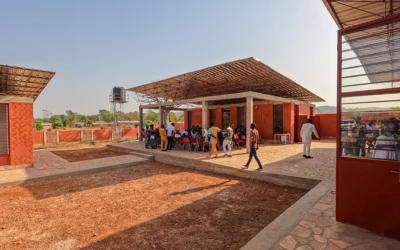
We have been looking forward to this day for a long time. On 20 January 2024, we opened our centre to the public and celebrated the topping-out ceremony and inauguration all in one with the mayor, priests and interested parties from Bersingou. Most of the buildings...

Tradition meets modernity
We didn't have to convince Felix Schürmann, professor of architecture at Biberach University of Applied Sciences, and his students. They were on board immediately. THE PROJECT JUSTINE - train the trainer not only offers the chance to really get to know the country and...

Why Benin?
The fact that we chose Benin is a coincidence. We sometimes hear ourselves say this. But it was no coincidence. The choice stands and falls with Justine Tchilalou Payarou, our first student, whom Marie and I trained as a seamstress in our Munich studio.WE HAVE LEARNT...

THE PROJECT JUSTINE
- train the trainer e.V.
Agricolaplatz 7
80687 Munich
THE PROJECT JUSTINE - train the trainer e.V.
IBAN DE71 4306 0967 8237 2376 00
BIC GENODEM1GLS
Please support us:
DONATE NOW AT

© THE PROJECT JUSTINE – train the trainer e.V.